Applies to: All companies registered with the ROCForm: Form 15
Of every filing a Sri Lankan company owes the Registrar of Companies, the annual return
is the one most likely to quietly lapse — not because it’s complicated, but because it isn’t
linked to anything a business normally tracks, like tax season or payroll.
It isn’t a financial filing
The annual return, filed on Form 15, has nothing to do with revenue, profit, or tax. It’s a
yearly confirmation of company facts — directors, shareholders, registered address,
share structure, auditors, and charges against company assets. Every company must file
it every year, including companies that are dormant or not currently trading.
When it’s due
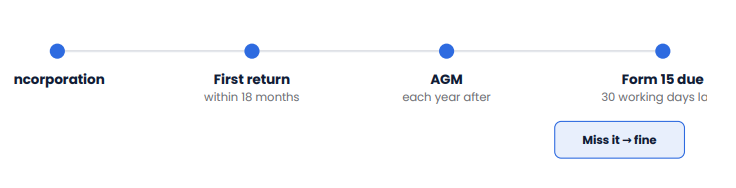
The first annual return is due within 18 months of incorporation. After that, it’s due
annually — in practice, this is usually tied to your company’s Annual General Meeting
(AGM), with Form 15 due within 30 working days of the AGM. If your company skips its
AGM, directors can instead pass a resolution covering the same matters, but that
resolution has to be filed alongside Form 15.
What it costs to miss
The Companies Act sets out fines for late or missing annual returns:
Up to LKR 100,000 against the company itself
Up to LKR 50,000 against each responsible officer or director individually
These aren’t one-off penalties for a single missed year — a company that has fallen
behind on multiple years of returns accumulates the obligation (and the exposure) for
each of them.
“We’re not trading” isn’t a defence. Dormant and non-operational companies still
have to file. If a company genuinely has no future use, the correct route is to apply to
strike it off the register — not to let returns lapse.
Why this slips through the cracks
Annual returns aren’t reminded by an invoice, a bank notice, or a tax portal — they
depend on someone in the business remembering the AGM date and the 30-working-day
window that follows it. For companies without a dedicated company secretary tracking
this, it’s easy for a year — or several — to pass unnoticed.
Not sure when your last return was filed?
We’ll check your company’s filing history against the Registrar and tell you exactly
where you stand, free.
This article is general information based on publicly available regulatory sources as of July 2026, and isn’t legal advice. Beneficial ownership regulations are new and specific requirements can vary by company structure — confirm your obligations with the Registrar of Companies or a qualified company secretary before acting
Compliance. Continuity. Confidence.
Venture BPO · 35A Fairfield Gardens, Colombo 08, Sri Lanka · 074 161 1741
No responses yet