Sri Lanka has introduced a mandatory beneficial ownership disclosure regime under the Companies (Amendment) Act No. 12 of 025, together with the Companies (Beneficial Ownership) Regulation No. 1 of 2026. In plain terms: it’s no longer enough for a company to be registered — the Registrar now needs to know who actually owns and controls it, not just whose name is on the paperwork.
Who counts as a beneficial owner
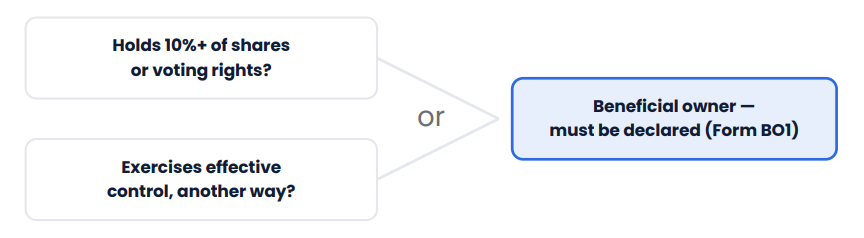
A beneficial owner is any individual who holds 10% or more of a company’s shares or voting rights, or who otherwise exercises effective control over it — regardless of whether their name appears on the share register or Articles of Association. This matters
most for companies with nominee shareholders, holding structures, or trust arrangements, where the person named on paper isn’t necessarily the person actually in control.
What newly incorporated companies must do
For companies incorporating from 30 March 2026 onward, the usual eROC steps (Forms 1, 18 and 19, plus the Articles of Association) haven’t changed. What’s new is a second stage: after eROC registration, the company must log into a separate government portal and submit two forms:
- Form BO5 — identifies the Authorised Person (AP), who must be a Sri Lankan resident responsible for maintaining the company’s beneficial ownership record.
- Form BO1 — the actual declaration, listing every individual who qualifies as a beneficial owner.
Until both forms are submitted, the incorporation isn’t treated as complete. If they’re skipped, the Registrar can require the incorporation to be resubmitted from scratch.
What existing companies must do
The requirement isn’t limited to new companies. Companies already on the register are also required to disclose their beneficial ownership, with a compliance window measured from when the law took effect. If your company was incorporated before 2026 and hasn’t submitted this information yet, it’s worth treating this as active, not historical — the window narrows every month.
Who can see this information
Full beneficial ownership records are available to regulators — the Financial Intelligence Unit, the Attorney General, the Inland Revenue Department, Customs, and other authorised bodies. A limited subset (name, address, and extent of ownership) is also
accessible to the public, with fuller access available through a Right to Information Act request.
Ongoing obligation, not a one-time form. Once submitted, the beneficial ownership register has to be kept current at the company’s registered office, with the Authorised Person responsible for updating it whenever ownership or control changes.
Why this is the update to act on now
Unlike an annual return or a payroll deadline, this is a new legal category most companies haven’t dealt with before — which means the most common failure mode isn’t lateness, it’s simply not knowing the requirement exists yet. If you’re not sure whether your company has filed, that’s the first thing to check.
Not sure if your company is covered?
We’ll check your beneficial ownership status against the current requirement, free, in
about 15 minutes.
This article is general information based on publicly available regulatory sources as of July 2026, and isn’t legal advice. Beneficial ownership regulations are new and specific requirements can vary by company structure — confirm your obligations with the Registrar of Companies or a qualified company secretary before acting
Compliance. Continuity. Confidence.
Venture BPO · 35A Fairfield Gardens, Colombo 08, Sri Lanka · 074 161 1741
No responses yet